
November 5, 2026
DOWNLOAD PERSPECTIVE
Since OpenAI launched ChatGPT in late 2022, Artificial Intelligence (“AI”) has become the dominant U.S. economic and market force. Lyell Wealth Management has devoted two prior Perspectives to AI, The Real Thing and Is It a Bubble?, and an update is timely.
Anthropic, which together with OpenAI is pioneering the AI frontier, defines AI as “a machine-based system that learns or is trained from data and, for explicit or implicit objectives and with varying levels of autonomy, processes that data to infer patterns, generate outputs ñ such as predictions, content, recommendations, and decisions ñ and act upon physical or virtual environments.“
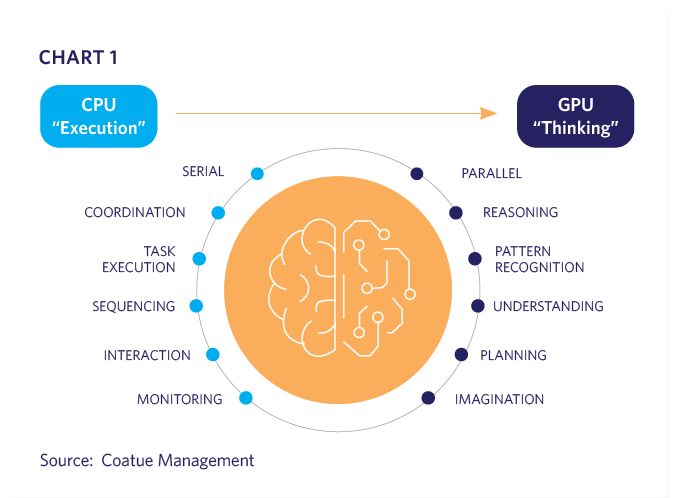
Growth investor Coatue Management (“Coatue”) distinguishes between AI and legacy technology by framing them as “Thinking” versus “Execution.” There are multiple dimensions where AI is significantly different, and it requires an entire infrastructure rebuild (Chart 1).
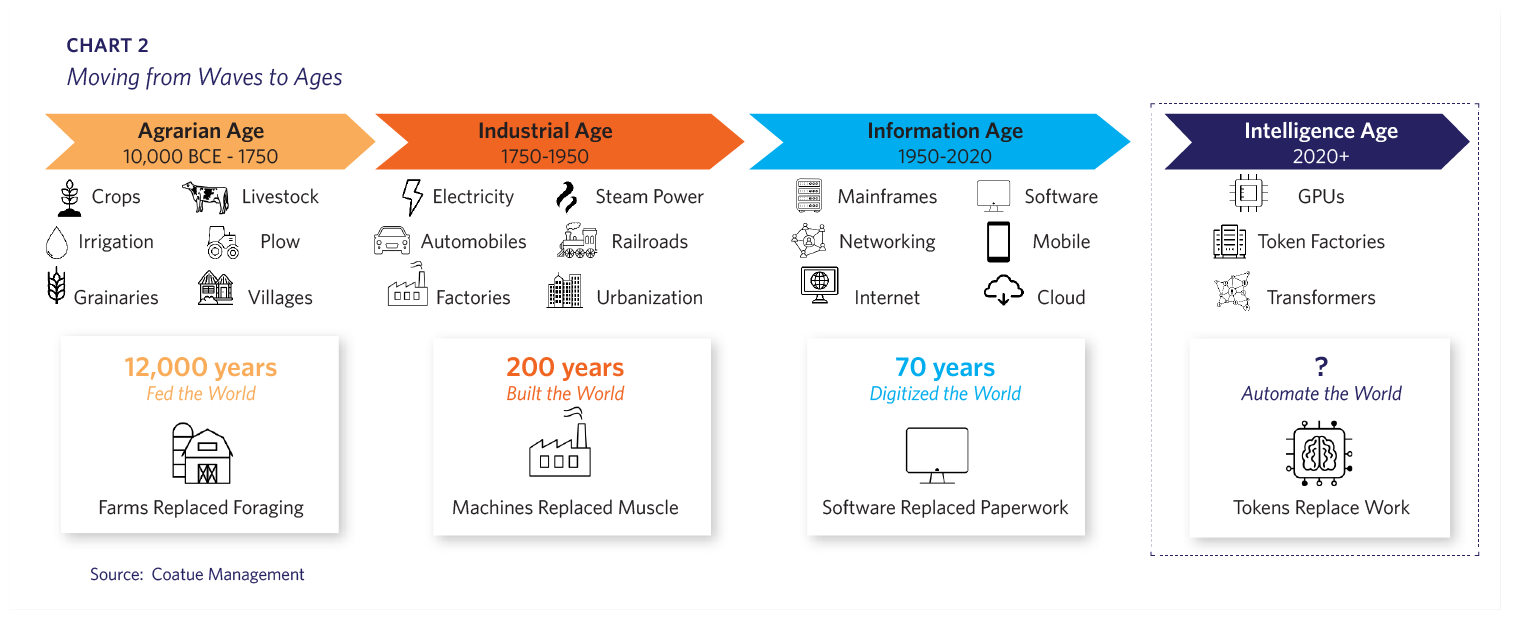
Coatue proposes that we are leaving the “Information Age” and entering the “Intelligence Age.” The Information Age was about digitizing the world and utilizing technology to communicate, organize, create and present data. It was human-directed. The Intelligence Age is about automating the world, with AI increasingly operating independently, often without humans in the loop. AI manufactures intelligence. This era may be as consequential as the transition from the Agrarian to the Industrial Age or the migration from the Industrial into the Information Age (Chart 2).
AI penetration is still in its early stages, but utilization is accelerating quickly. Technology and media have led the way, particularly in software coding, with total spending per employee rising nearly tenfold since 2025 (Chart 3). Not coincidentally, AI agents surpassed humans in token usage by February 2026, as token demand is decoupling from the number of human users and scaling non-linearly. A token is a unit of data that AI models use to break down and make sense of language.

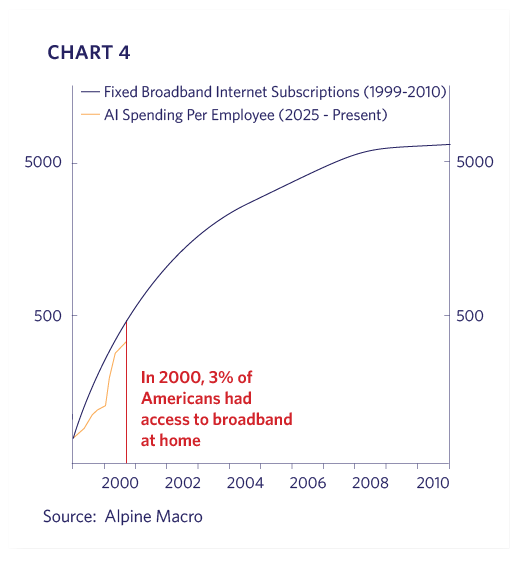
Research firm Alpine Macro estimates that AI spending per employee is at a stage analogous to U.S. broadband adoption in 2000, when only 3% of Americans had access at home (Chart 4). This seems intuitively correct, as adoption that might seem inevitable is being slowed by security concerns, regulatory constraints, and some employee resistance. “Change management” across large and small enterprises will take much longer than the early AI proponents promised, but widespread adoption seems highly likely over time.
The largest U.S. AI infrastructure companies, aka “hyperscalers,” are experiencing very strong revenue growth. In the third quarter of 2026, Microsoft Azure, Amazon Web Services (“AWS”), and Google Cloud grew revenues year-over-year by 48%, 39%, and 103%, respectively. Equally impressive is the growth rate of their revenues per employee (Chart 5). Although the dynamics driving corporate productivity are difficult to pinpoint, the recent surge in revenue per employee across the S&P 500 is likely being driven, at least in part, by early AI adopters lifting the broader group (Chart 6). For example, Microsoft has increased its revenues from $198 billion to $331 billion over the past five years while keeping headcount flat. The company also recently offered buyout packages to more than 25% of its workforce, or approximately 60,000 employees.


Anthropic’s recent IPO filing provides key disclosures. The company generated over $16.9 billion in revenues in the third quarter of 2026, as compared to approximately $4.6 billion for all of 2025. Anthropic has more than 11,900 enterprise customers that each generated more than $100,000 in revenues for the prior twelve months, compared to approximately 1,500 at year-end 2025. Nearly 2,000 customers generated over $1 million in revenues during the past year. Anthropic reported a Net Retention Rate of 900% in the third quarter of 2026, meaning existing customers increased their spend ninefold compared to the prior year.
This revenue growth is not being subsidized by loss-leader pricing. Economies of scale resulting from Anthropic’s growth have reduced infrastructure and compute costs to less than half of revenues (Chart 7). Each dollar of new revenue earns Anthropic approximately 39 cents of operating income. Its current inference gross margin is 85%.

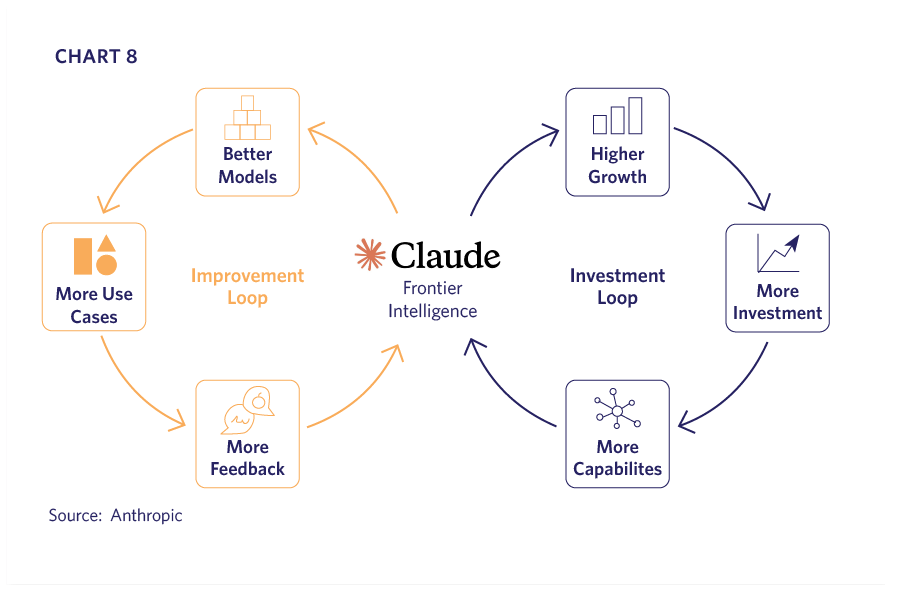
How has Anthropic achieved this historically unprecedented growth? Its business model is built upon the premise that massive investment and expertise in frontier models will enable more customer use cases, generating new data which can be incorporated back into their models. This strong growth, in turn, enables Anthropic to reinvest in its capabilities and extend its ability to provide better models (Chart 8). OpenAI is employing the same strategy.
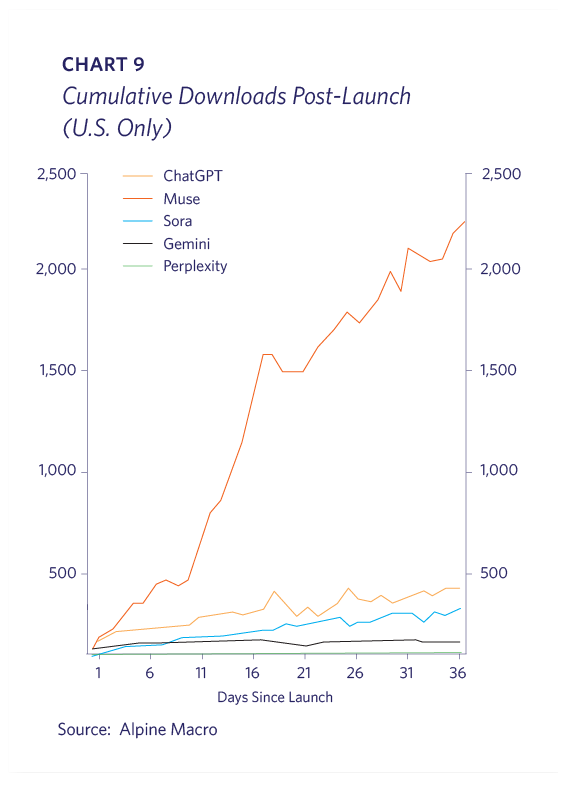
OpenAI’s ChatGPT has 1.2 billion weekly active users. As of March 31, 2026, it had over 50 million paid consumer subscribers and an additional nine million paying business users. Meanwhile, Meta’s Muse agent adoption dwarfed prior U.S. AI launches, and many Americans are in the early stages of exploring agentic commerce (Chart 9). Monetization in many cases is developmental and immature at this point, but many users now view AI as essential. Recall that Google didn’t launch advertising for two years after it launched search.
AIthough OpenAI and Anthropic are the leading U.S. frontier labs, AI is not just a two-horse race. In addition to the offerings from SpaceX.AI, Google and Meta, open source/open weight models are increasing their market share (Chart 10). Many use cases and applications do not require the very best models, and the cost-benefit analysis drives users to less expensive options. Increasingly, business users are using different models interchangeably based on the specific task and current cost. To add to this complexity, with increasingly agentic workloads, there are instances in which a frontier model agent coordinates open-source agents to complete difficult tasks.

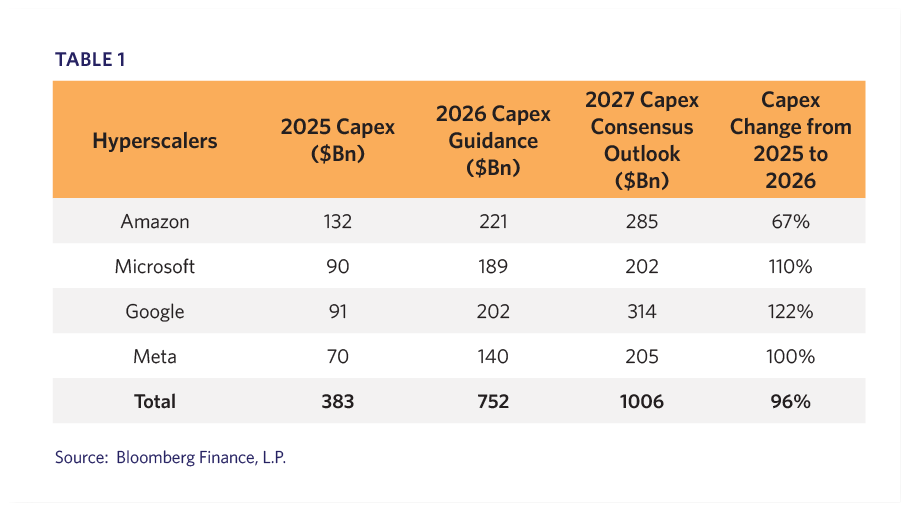
Understanding the above economic transformation explains why there is such massive capital investment underway. The hyperscalers will collectively almost double their capital expenditures from 2025 to 2026, with over $1 trillion in investment (Table 1). ISI projects total AI capex to exceed $1.4 trillion in 2027, and BofA Securities projects datacenter spending to reach $2.1 trillion in 2028.
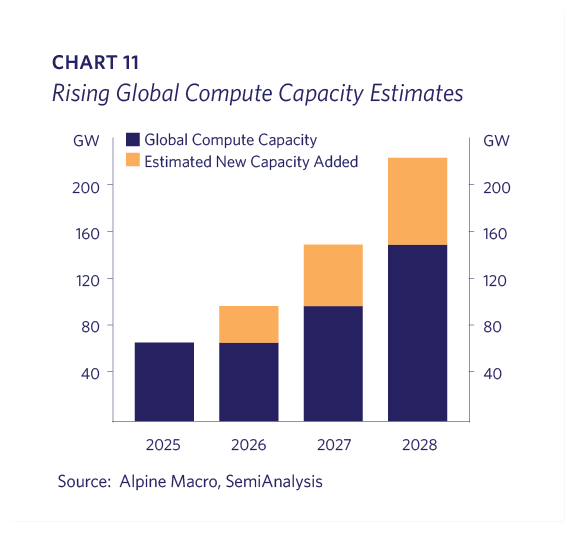
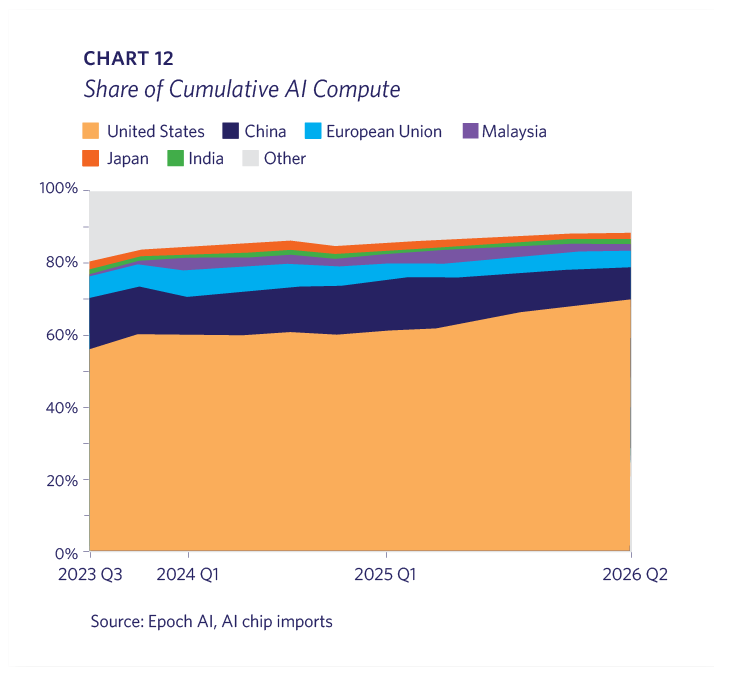
AI is a global race with the U.S., China and select Asian countries engaged. By 2028, global compute capacity is projected to have tripled in the previous three years (Chart 11). The U.S. is currently the leader in compute capacity, due to its access to leading AI semiconductor technology (Chart 12).
The frontier labs have increasingly been harnessing AI in their own research and development efforts. Anthropic reports that 26% of its AI projects are now AI-led, although humans remain involved in the process (Chart 13). The dream of AI founders is “recursive self-improvement” or “RSI” which enables AI to act without any human involvement. This is the final theoretical step, though it is not clear it is achievable. However, this stage is the one with the most profound societal implications.

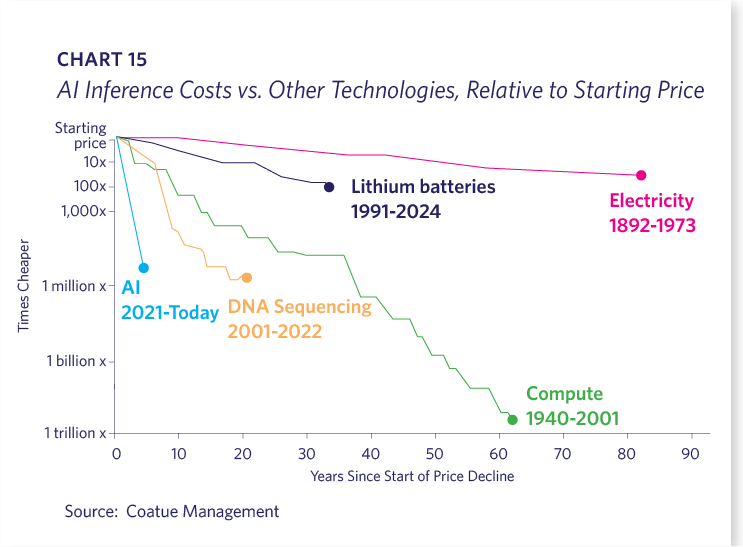
As a result of semiconductor advances, greater compute, and more intelligent architectures, AI capabilities have been accelerating (Chart 14). AI inference costs, which are those incurred when using models and generating tokens, have plummeted at an unprecedented rate when compared to prior technological advances (Chart 15).

The markets are alternately thrilled by the vast potential of AI and terrified by the enormous amount of capital necessary to realize it. The hyperscalers are using virtually all of their massive cash flows to invest in AI, and, with the exception of Microsoft, issuing debt and equity to fund additional investment. However, market concerns appear to be overlooking the rapid payback period on these investments. Illustrating this point, Amazon CEO Andy Jassy has stated that they expect a three year project payback, suggesting that cash flow should begin replenishing its coffers within that timeframe, and that perpetual additional debt financing will not be necessary.
New entrants, known as neoclouds, are also building or leasing out facilities to provide compute to leading AI companies, primarily OpenAI and Anthropic. Nvidia has strategically supported many neoclouds through investments and guarantees to broaden its customer base and lessen its dependence on the hyperscalers (who have also developed their own semiconductors). The financial media has become increasingly concerned about this “circular financing.” Nvidia’s total contractual investments and guarantees are $170 billion. This figure is less alarming when one realizes that Nvidia will generate over $180 billion in free cash flow in just this year!
There is, however, a major customer concentration issue in that the two frontier labs represent a substantial portion of commitments and backlogs. Although the data is opaque, it appears that more than 40% of AI capital investment is dedicated to OpenAI and Anthropic. Anthropic alone has $895 billion of compute spending commitments with partners including Amazon and Google.
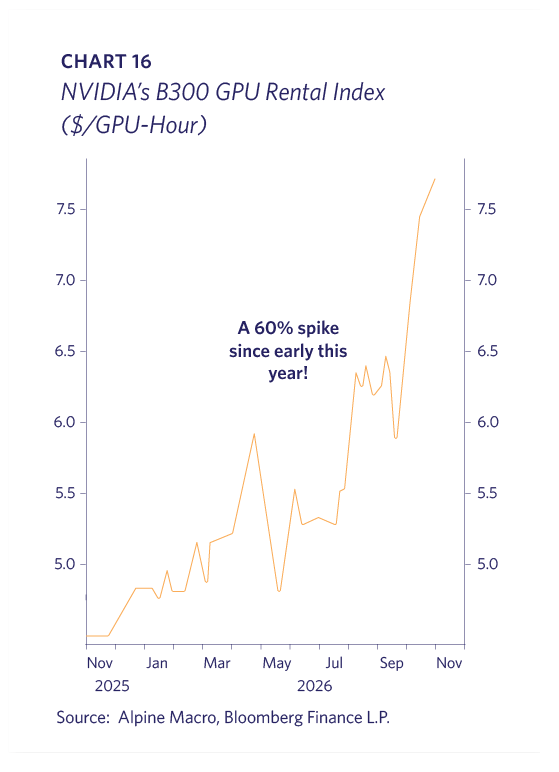
Some have likened the massive AI infrastructure cycle to the 1990s telecom bubble. A key difference is that 97% of the optical fiber laid in the 1990s was “dark,” meaning it was not being used because demand had yet to materialize. AI has been perpetually lacking in sufficient compute, and new capacity is readily leased as soon as it becomes available. Highlighting the excess demand environment, Graphic Processing Unit (“GPU”) rental rates have been rising throughout the year (Chart 16). GPUs are the core engine used to train and run AI models. It is worth noting that many neocloud providers have contracts with pricing below current market rates, suggesting that their economics would improve if these contracts were marked-to-market.
It is Lyell Wealth Management’s assessment that we will see some AI companies fail, which is inevitable in an era in which there is great opportunity and risk. To some extent, we are currently seeing a venture capital mindset at work. The neoclouds are non-investment grade, and their borrowing costs have recently escalated significantly. It seems likely that there will be a shakeout among AI infrastructure providers over time. However, it appears that weaker players in the AI infrastructure sector will likely have their operations and/or assets absorbed by the stronger players. This also suggests that the hyperscalers are wise to leverage their balance sheets and cash flows to compete, as some smaller players may lack the financial capacity to keep up.
Thus far this AI discussion hasn’t referenced robotics and autonomous-driving vehicles, which are already among us. “Physical AI” will add to the use cases discussed above, as well as those yet to be imagined. It therefore seems likely that AI infrastructure will be heavily utilized, making fears of overcapacity appear premature.
We share the concerns of many about the societal and economic implications of such profound change. It is appropriate that our policy makers and government representatives ensure that appropriate safeguards and liability exist to avoid catastrophic outcomes. However, in our view, efforts to stop the emergence of this new AI world will be no more successful than the Luddites’ attempts to halt the Industrial Revolution.
The statements by Anthropic and OpenAI that the AI capabilities they are pioneering may pose an existential threat to humanity are unprecedented. We have wrestled with the dichotomy of companies continuing to advance technologies they acknowledge may pose such risks. One perspective is that the frontier AI labs are attempting “regulatory capture,” whereby the government imposes constraints that only they can satisfy, effectively stifling future competition. We take some solace in the views of experienced industry insiders, such as Jensen Huang, Satya Nadella, and Marc Andreesen, who believe that AI safety is fundamentally an engineering challenge that can be solved. Putting the responsibility squarely on AI companies, and ensuring they cannot absolve themselves of liability, seems to be the right path forward. If a product risks destroying humanity, then it should not be released.
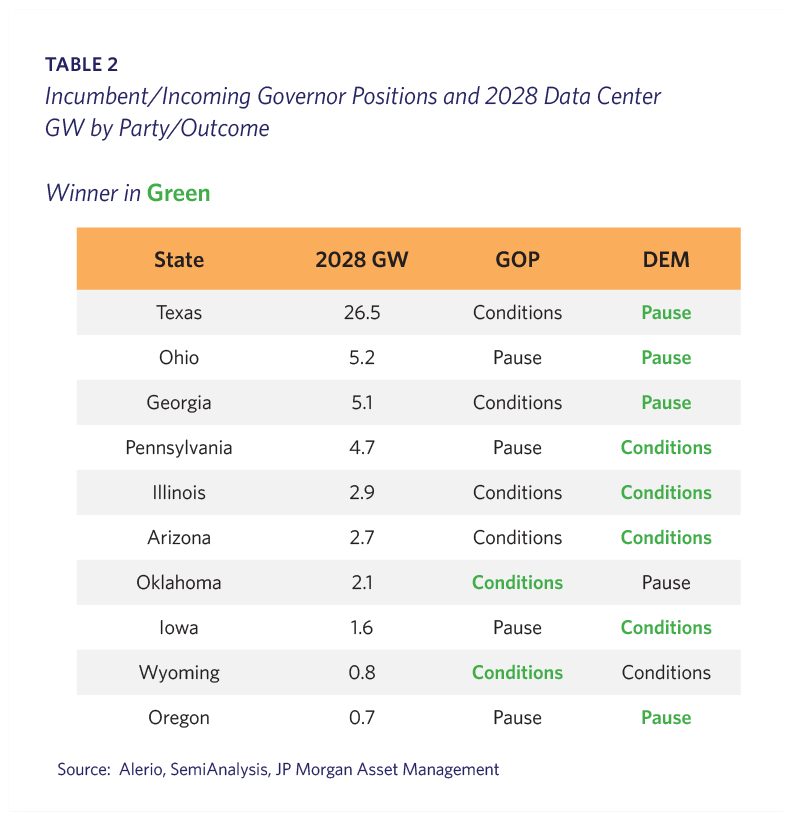
Data center development has become a major political issue in the U.S., drawing bipartisan opposition and featuring prominently in many 2026 state and local elections. The positions of Republican and Democratic governor candidates in key states ranged from imposing minimum development conditions to calling for an outright pause in construction (Table 2).
Power generation and the question of who pays for it have been very poorly managed by much of the AI industry thus far. It is politically untenable for new AI data centers to draw on existing electricity supplies in ways that cause consumers and other businesses to face higher power bills. Going forward, data center development will involve economic incentives for affected communities, and developers may increasingly be required to “bring their own power” as part of their projects. A large Amazon data center in New Carlisle, Indiana, is a good model of what is necessary. In addition to a projected $2 billion in property taxes over 35 years and 1,000 full-time jobs, Amazon contributed $9.5 million toward fire equipment, law enforcement, roads, water-quality initiatives and student programs. The construction also employed approximately 4,000 skilled tradespeople. While there is no doubt that many communities across the U.S. oppose data centers, we expect there are others eager to embrace the economic benefits that New Carlisle has received.
However, part of the AI opposition is based on an inaccurate understanding of the amount of water data centers consume. Modern designs incorporate recycling that greatly reduces consumption. A widely cited 2025 book, Empire of AI, mistakenly overstated data center water use by approximately 1000x, which the author has subsequently adjusted; however, this inaccuracy is frequently referenced by data center opponents as a rationale for local opposition.
There has been a severe AI-led stock market selloff since the November 3rd elections that seems unwarranted. The newly elected Democratic governor of Texas announced that all currently permitted data centers will be allowed to finish construction, covering projects slated for 2027 and into 2028. This is significant because Texas represents 25% of planned U.S. data center capacity. Newly permitted data centers in Texas will need to comply with a handful of conditions that do not appear substantially different from what Amazon delivered in Indiana. We doubt that fewer data centers will ultimately be built than would have been prior to the elections, although some timelines could be pushed out. In fact, this may prove beneficial if the unsustainable pace of AI infrastructure development moderates to a more manageable rate, easing supply-chain bottlenecks and extending the AI investment cycle. It also may make space-based data centers more economically feasible.
The reality is that AI has direct national security implications, and the United States faces a peer adversary in China that is eager to surpass the current lead held by U.S. companies. Although the U.S. has a compute advantage, China has massive power generation capacity and an all-of-the-above energy policy that the West cannot hope to match. It will be incumbent upon the U.S. to find solutions that provide sufficient power generation while placing the financial burden on industry rather than local communities.
The “AI trade” has experienced wild swings since October 2022, most recently over the past week. It is Lyell Wealth Management’s view that the fundamental drivers of this generational theme remain intact and that the recent volatility is simply another of the many pauses that we have experienced since this bull market began.